This advertorial is sponsored by Bentley.
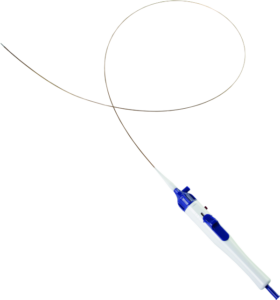
Over the last two decades, endovascular treatment has developed as the preferred strategy for chronic complex iliac occlusions due to lower procedural time and risk, and proven long-term patency in comorbid patient groups. While contemporary trials seek to identify whether the clinical and cost-effectiveness of open surgery for severe occlusive aortoiliac disease is superior to endovascular treatment, the latter is typically selected even for complex TASC C/D iliac artery chronic total occlusions (CTOs). Here, one expert describes her clinical experience with the BeBack crossing and re-entry catheter (Bentley), underscoring the importance of early escalation and preserving treatment options in the context of complex disease.
Katherine Lews (Somerset NHS Foundation Trust, Taunton, UK) describes that endovascular treatment of iliac CTOs typically begins with an attempt to cross the occlusion using a variety of guidewires and catheters. This step remains the most technically demanding part of the procedure.
“CTOs often exhibit dense fibrosis, circumferential calcification, and complete loss of luminal architecture, making true lumen passage difficult. Using larger-bore catheters and hydrophilic wires can often result in formation of a wide subintimal plane which extends beyond the bifurcation into the distal aorta, causing dissection and extending the landing zone of any ‘kissing’ iliac stents”, Lewis explains.
Once an established subintimal tract is formed, thrombus precipitates in the dissection flap and it can be challenging to convert and re-enter the intraluminal passage. Therefore, Lewis emphasises, early use of a targeted crossing and re-entry device can avoid potential complications.
Lewis explains that additional complexity is a given due to the diverse plaque morphology within iliac CTOs, which generally consists of heavily calcified proximal and distal plaques with areas of mixed-morphology or fibrous fatty-plaque within the mid occlusion. This results in catheter-wire combinations, traversing the occlusions with mixed subintimal and intraluminal passages. “The ability to interchange between these strategies with a single device, minimising the need for catheter exchange, is beneficial,” she notes. “This reduces procedure time, exposure to radiation and risk of losing wire access.”
Rather than simply achieving passage through an occlusion, controlling where and how the lesion is crossed is essential. Even in iliac CTOs, Lewis suggests initiating the crossing intraluminally either with specialised CTO crossing catheter or weighted wire to pierce any calcified cap.
“It is then possible to cross largely intraluminally, avoiding the creation of a wide dissection flap, which can cause complications,” she describes. “The BeBack catheter can also be used for this purpose with the steerable, length-adjustable nitinol needle used on the lowest—3mm— setting to initiate tracking so that the catheter can be traced over a wire.”
Today, many operators begin with standard wire-and-catheter techniques prior to escalating if they encounter difficulties. And to Lewis, this is not “unreasonable”. However, she believes that “early escalation to a crossing catheter and a 0.018-inch CTO wire is preferable, and consideration of a re-entry device, as opposed to persisting with multiple catheter-wire combinations, makes the likelihood of technical success in a single session higher and avoids the patient reattending for a further procedure”.
As for aortoiliac occlusive disease cases, Lewis emphasises the importance of the crossing route to preserve the intended reconstruction. “It’s not only about crossing the occlusion, but early re-entry into the lumen at the bifurcation.” She adds that the BeBack catheter—with a 360-degree rotational Nitinol needle and a clear directional C-shaped marker—can enable precise luminal re-entry at the bifurcation, which allows for intended geometry, improving flow dynamics.
In heavily calcified iliac lesions, vessel preparation technologies, such as intravascular lithotripsy (IVL) are used before stenting. In these cases, staying intraluminal is “beneficial although not essential to ensure close contact between the transmitted ultrasound wave and plaque,” Lewis notes. “If the wire takes an uncontrolled subintimal route, vessel preparation and final stent expansion may become less predictable and can extend further into the aorta,” she describes. In Lewis’s experience, BeBack can help preserve a controlled route through the lesion or support targeted re-entry when needed.
Imparting advice to operators seeking to improve procedural predictability when managing complex iliac CTOs, Lewis advocates for controlled intraluminal passage “wherever possible”. She acknowledges that this can sometimes be achieved with a standard catheter and hydrophilic wire combination, but if an initial attempt using this approach is unsuccessful, then early escalation to the BeBack catheter is preferred.
“Adopting this strategy—using a dual-purpose crossing catheter and controlled re-entry device—has proven highly successful,” Lewis shares. “It can be used for retrograde and antegrade approaches. The length-adjustable needle and directional rotational markers allow controlled passage and precise re-entry into the true lumen, and this minimises complications, extensive dissection and allows for treatment in one sitting.”
Case report
A male in his 50s had previously experienced life-limiting claudication at 20 metres walking distance, which had been affecting his ability to work as a chef. Following computed tomography (CT) imaging, a 5cm right iliac occlusion from the aortic bifurcation was identified with significant claudication in the distal aorta. Previous retrograde crossing had failed with precipitation of a subintimal tract into the aorta.
Following a three-month window to allow remodelling, the patient was rebooked with a plan to use the 4Fr BeBack crossing and re-entry catheter as first-line treatment, followed by deployment of a balloon expandable covered stent graft. As an adjunct, the Cydar EV (Cydar Medical) image fusion platform was employed to overlay the occlusion and plan targeted re-entry (Figure 1).
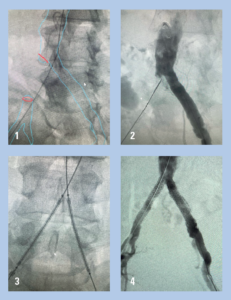
The 4Fr BeBack catheter of 120cm in length was used as a crossing catheter with the 0.018- inch Asahi Gladius and Halberd (Asahi Intecc) to cross the distal occlusion intraluminally. However, conversion to subintimal passage at the proximal aspect was required with targeted re-entry at bifurcation using the BeBack device. Figure 2 shows orientation of the device using C-shaped radiopaque markers with directional control of the needle tip to re-enter the lumen medially at the aortic bifurcation. Once intraluminal access was established, a 10x57mm balloon expandable covered BeGraft stent was deployed in the common iliac artery due to calcific burden (Figure 3), with excellent angiographic and haemodynamic results restoring patency and flow (Figure 4).