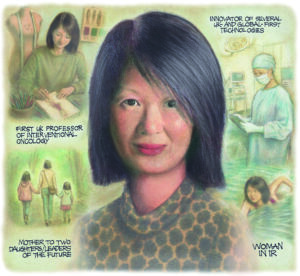
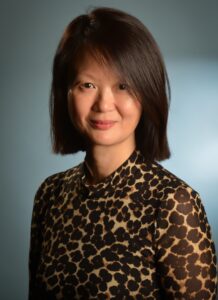
 Driven by a passion for both science and art, professor of interventional radiology (IR) Tze Min Wah (Leeds, UK) has built a career that combines innovation, technical expertise, and creativity. After initially pursuing surgical training, she discovered IR—a specialty that blends clinical practice with procedural innovation. Today, as a consultant interventional radiologist at Leeds Teaching Hospitals NHS Trust, she combines patient care with pioneering research, advancing new technologies and pushing the boundaries of IR in research and education. Here, Wah tracks key career highlights with Interventional News.
Why did you initially choose to become a doctor and what was it that made you decide to specialise in IR?
Growing up on the tropical island of Penang in Malaysia, I was equally captivated by art and science. As a child, I dreamed of becoming a fashion designer, drawn by the creativity and innovation of the design world. However, my aptitude for science gradually steered me towards medicine—a direction gently encouraged by those around me.
Throughout medical school and my early years as a house officer, I enjoyed clinical practice but felt that something was missing. That changed during my surgical rotation in the professorial surgical unit, where I first encountered interventional radiologists. I was fascinated by their ability to solve complex clinical problems, often providing lifesaving minimally invasive treatments when conventional approaches had reached their limits. They were the team everyone relied upon in difficult situations, combining technical expertise with clinical judgement to make an immediate difference to patient care. It was then that I realised that IR represented the missing piece of the puzzle for me.
Towards the end of my house officer training, I was offered a senior surgical house officer post in the professorial surgical unit. I remember joking with the two professors that perhaps I would be more useful as an interventional radiologist, so that I could always help them whenever they needed IR support. They both laughed and remarked that, if they had the opportunity to choose their careers again, they too would choose IR. That conversation marked the beginning of my IR journey in 1996.
After securing a radiology training post in Leeds, I quickly discovered that pursuing IR as a woman was not universally encouraged. At that time, misconceptions surrounding radiation exposure during pregnancy, together with the perception that IR was a male-dominated specialty with poor work–life balance, created significant barriers. During my second year of training, I came close to leaving the specialty altogether.
Who were the biggest influences on your early career?
Everything changed when I met Dr Sam Chakraverty during a rotation at a district general hospital. He welcomed me into his interventional practice, entrusted me with increasingly complex procedures and, most importantly, believed in my potential. Those three months transformed my career trajectory. They rekindled my passion for IR and gave me the confidence to persevere despite the challenges. I remain profoundly grateful for his mentorship, which fundamentally changed the course of my professional life.
Could you describe one of your most memorable cases?
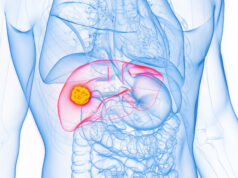
Among the many memorable patients I have had the privilege to treat, one experience stands out above all others. In 2021, we performed one of the first liver treatments in the global #Hope4Liver trial, evaluating image-guided histotripsy for liver cancer. Histotripsy represents a completely different treatment paradigm, using focused cavitating ultrasound to mechanically destroy tumour tissue without needles or ionising radiation.
The following morning, I visited my patient, Sheila, expecting to assess her recovery. She told me she had experienced no pain. When I asked if I could examine her wounds, she smiled and replied: “There are no wounds.” At that moment, the significance of what we had achieved truly resonated with me. We had reached a point where meaningful cancer treatment could be delivered entirely non-invasively. It was one of those rare moments that reminds you why innovation in medicine matters.
You were the first UK professor of interventional oncology (IO). What drove you to pursue this qualification in a relatively underdeveloped field?
Research has always been central to my vision of practising evidence-based medicine. During my radiology training, I aspired to undertake a PhD, believing it would provide the academic foundation necessary to advance IR. At the time, however, there was little encouragement to pursue research because of workforce demands. The priority was understandably to train more practising interventional radiologists.
Rather than abandoning that ambition, I sought permission to undertake a PhD after becoming a full-time consultant. My organisation generously supported the opportunity, although the research itself had to be completed almost entirely in my own time—during annual leave, evenings and weekends. Importantly, I was working in an institution without an academic radiology department, making the journey even more challenging.
I was exceptionally fortunate that Prof Peter Selby agreed to supervise my doctoral studies. Looking back, I embarked on the PhD with little appreciation of how demanding the journey would become. Balancing a full-time consultant practice while raising two young daughters required considerable perseverance and, above all, the unwavering support of my husband, family and colleagues.
When I successfully defended my PhD, Selby remarked that he was particularly proud because, statistically, the likelihood of completing such a journey under those circumstances was remarkably low. His words have stayed with me ever since. There were undoubtedly moments when others believed in me more than I believed in myself, and I remain deeply grateful for their encouragement.
My PhD marked the beginning rather than the culmination of my academic career. For many years, research remained something I pursued alongside a full-time clinical practice. It was only after my appointment as the UK’s first professor of IO in 2022, followed by the award of the National Institute for Health and Care Research (NIHR) Senior Clinical and Practitioner Research Award (SCPRA) in 2024, that I was able to dedicate protected time to developing a truly integrated clinical academic programme.
Everything I do in research is underpinned by a simple principle: patients deserve the highest quality, evidence-based care. Innovation alone is never enough; it must be supported by robust scientific evaluation before it can become routine clinical practice. That philosophy continues to drive my commitment to research in IR.
How did you become involved in research for histotripsy and what role will the modality play in the future treatment of liver tumours?
In 2020, at the height of the COVID- 19 pandemic, I was approached by the research and innovation team at HistoSonics regarding the possibility of introducing histotripsy at my centre in Leeds. My initial reaction was that the timing seemed almost impossible. However, following discussions with our multidisciplinary team, we recognised the potential importance of the technology.
My instituion subsequently underwent a competitive international selection process and was chosen as the chief investigator site for the #Hope4Liver trial in the UK. In 2023, we were also privileged to perform the world’s first image-guided renal histotripsy treatment. This technology is transformative and we will have many exciting opportunities to translate this into various organs and diseases in years to come.
What is the biggest challenge facing IO (or IR) today?
Looking ahead, I believe the greatest challenges facing IO are workforce sustainability and the pace of technological innovation. Novel technologies are evolving more rapidly than our traditional evidence-generation pathways.
We need more agile and proportionate approaches to evaluating medical technologies, enabling promising innovations to be translated safely and efficiently into definitive clinical trials and, ultimately, routine patient care.
Were there any career risks you took that, in hindsight, proved pivotal?
Reflecting on my career, two decisions have shaped my professional life more than any others: persevering in my pursuit of IR despite significant obstacles and insisting on pursuing a PhD when the conventional path would have been to focus solely on clinical service. Those decisions taught me that resilience, supported by good mentors and colleagues, can transform challenges into opportunities.
What does your life outside of medicine look like?
Outside medicine, I enjoy travelling, particularly when it allows me to spend time with my parents and siblings in Malaysia. I also enjoy water sports, cooking and, perhaps unsurprisingly, I still indulge my lifelong interest in fashion design whenever time permits.