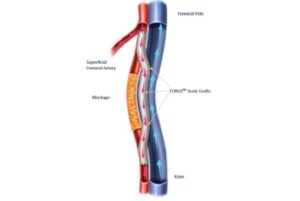
Endologix today announced publication of 36-month results from the DETOUR2 clinical trial evaluating percutaneous transmural arterial bypass (PTAB) using the Detour system in the Journal of the Society for Cardiovascular Angiography and Interventions (JSCAI).
The DETOUR2 trial is a prospective, single-arm, international, multicentre clinical evaluation of the safety and effectiveness of PTAB using the Detour system in patients with long and complex femoropopliteal lesions. The study enrolled 202 patients across 32 clinical sites and results demonstrated sustained safety and durable clinical outcomes through 36 months, supporting PTAB with the Detour system as a minimally invasive alternative for patients with complex peripheral arterial disease (PAD). This publication comes on the heels of additional progress with the PTAB1 study, a prospective, multicentre, real-world registry evaluating the safety and clinical performance of the Detour system, which has now enrolled more than 200 patients and is tracking outcomes in patients with complex, long-segment PAD.
“Long-segment femoropopliteal disease remains one of the most challenging areas in peripheral vascular intervention,” said Prakash Krishnan (Icahn School of Medicine at Mount Sinai, New York, USA) and lead author of the study. “The DETOUR2 results demonstrate that percutaneous bypass using the Detour system can deliver durable outcomes through three years with favourable safety, providing an important treatment option for patients with complex SFA [superficial femoral artery] disease.”
The study shows strong long-term outcomes in a highly complex SFA disease patient population with a mean lesion length of 32.7 cm, 96% chronic total occlusions (CTO), and 70% severely calcified lesions.
Primary patency at 36 months was defined as 58.2%, while patency defined as freedom from occlusion (flow/no flow) was 84.0%. Freedom from clinically driven target lesion revascularisation (CD-TLR) was 66.8% and freedom from major adverse limb events (MALE) was 64.5%. The authors report freedom from major amputation was 97.9% (unchanged from 12m) and symptomatic deep vein thrombosis (DVT) was 4.1%, with no pulmonary emboli reported (unchanged from 12m). Clinical success, defined as improvement in Rutherford clinical classification, was achieved in 96.7% of patients at 36 months, reflecting sustained improvement in symptoms and functional status.
“These findings highlight the durability of PTAB with the Detour system in treating long, complex lesions that historically have required open surgical bypass,” said John Liddicoat, president and chief executive officer of Endologix. “The ability to deliver comparable durability with a minimally invasive procedure represents a meaningful advancement for physicians and patients managing complex peripheral arterial disease.”