 Obsidio (Boston Scientific) conformable embolic was safe and effective across a broad range of target vessels in the OCCLUDE registry, with 100% technical and clinical success and a low rate of major adverse events (MAEs), according to findings from a multicentre real-world study published in the Journal of Vascular and Interventional Radiology (JVIR).
Led by Ketan Y Shah (MD Anderson Cancer Center, Houston, USA), OCCLUDE is a prospective, single-arm clinical registry that enrolled 125 patients at 19 centres. All patients underwent vascular embolization with Obsidio and were followed for one month. The study aimed to evaluate the real-world effectiveness and safety of the embolic agent.
The primary effectiveness endpoint was technical success, defined as occlusion of the target vessel or vessels, confirmed by angiography or by visualisation of an Obsidio cast on fluoroscopy or other imaging immediately after embolization. Clinical success, a secondary endpoint, was defined as the absence of target vessel bleeding within 30 days.
The primary safety endpoint was freedom from MAEs through 30 days. MAEs were defined as non-target embolization meeting serious adverse event criteria, unintended target organ or soft tissue infarction, vessel perforation or injury, or catheter entrapment.
The median patient age was 63 years; bleeding or haemorrhage was the most common indication, accounting for 98 patients (78.4%), followed by hyper vascular tumour (HVT) in 19 (15.2%) and other indications in eight (6.4%). A single target was embolised in 111 patients (88.8%).
Renal arteries accounted for 25.5% of those treated, non-gastrointestinal (GI) visceral arteries for 17.4%, upper GI arteries for 9.3%, extremity arteries for 3.7% and lower GI arteries for 2.5%. The remaining 41.6% were classed as other.
A total of 161 vessels were embolized, and, of these, 38 (23.6%) were treated with another embolic in addition to Obsidio, and in 84.2% of these cases the additional agent was used before Obsidio.
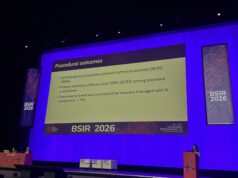
Technical success was achieved in 100% of cases. Clinical success was assessed in the 105 patients treated for haemorrhage (n=98) or bleeding HVT (n=7). Among the 97 evaluable patients, clinical success was 100%, with no rebleeding. The remaining eight patients lacked 30-day follow-up and could not be evaluated. Freedom from MAEs was 97.4% (113/116), and no cases of catheter entrapment occurred.