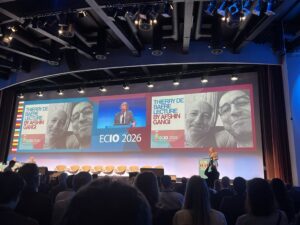
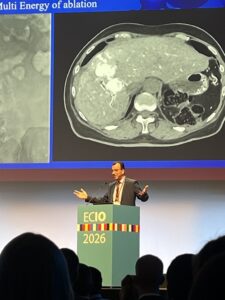
Afshin Gangi (University Hospital of Strasbourg, Strasbourg, France) presented the Thierry De Baère Lecture at this year’s European Conference on Interventional Oncology (ECIO; 26–30 April, Basel, Switzerland)—the first of its kind in honour of the late De Baère’s extensive contribution and dedication to the field of interventional oncology (IO).
Gangi’s talk took stock of conversations and concerns gaining traction among clinicians in this space, including on topics such as artificial intelligence (AI) and patient ownership. His discussion also placed particular focus on welcoming technological innovations of today: “I can see better with my glasses than without my glasses, so I wear them. It’s the same principal,” said the speaker.
To mark how far technology has come, Gangi recalled his early years and the first use of “hybrid” in reference to the operating room. “I remember when I first began putting a C-arm in front of a CT [computed tomography] scanner,” he said. “I was younger then, better looking and with no glasses. Everybody told me it was a waste of time and money when I presented at the Gustave Roussy [Villejuif, France] on having the C-arm and CT in the room together—they killed me. Then, Thierry came up after me, and they killed him too,” Gangi told the ECIO 2026 audience. “Too afraid” to present in France following this initial rejection, Gangi and De Baère took their insights further afield, presenting their papers in the USA and elsewhere in Europe.
No longer seen as “luxuries” today, Gangi upheld that these tools should be seen as vehicles for progression for IO. He acknowledged that arguments can be drawn over cost; however, he used the example of robotic surgery to dismiss these. He stated that, at his own institution, the three surgical robots that are in use treat a maximum of two patients a day, “yet our entire hybrid OR costs less than one robotic system”, Gangi claimed.
The speaker highlighted interventional magnetic resonance imaging (MRI) as an “important goal” for interventional oncologists to strive toward. “It’s tiring to see clinicians resisting this,” Gangi said. “Interventional MRI means no radiation, no lead aprons—freedom. We’re so used to wearing lead that we don’t even complain anymore.”
He described the first prostate cryoablation performed using interventional MRI, recalling that “nothing was adapted for MR guidance outside of the cryoprobes, everything had to be invented. We even used a garden table for the procedure.” Showing a clear image of the ice ball formed during this case illustrating that the ablation was complete, Gangi underscored that this result is why innovation is “worth fighting for”.
“It took 15 years to go from puncturing onions in the laboratory to performing this clinically. And now we are on our third-generation MR suite. We have two interventional MR systems in the department, and we use them constantly. Again, people say it is difficult or expensive, but the real issue is fear of the unknown,” he told ECIO attendees.
Gangi concluded his talk with statements of aspiration, extolling interventional oncologists for having “the best job in medicine”. He added that they “should be ambitious” and must ask for the tools needed to allow them to perform to the best of their ability.
“If we want to do complex interventions and push our field forward, we deserve [these tools]. Multimodal imaging belongs to us, and we are masters of all imaging techniques—ultrasound, CT, PET [positron emission tomography] MR. We are the ones who can use these tools best, so be ambitious. Don’t go to your CEO asking for 100,000. Go asking for millions. If your vision is strong enough, they will listen,” Gangi bolstered.