Microwave ablation demonstrated “excellent” technical and early oncologic outcomes, with low local tumour progression (LTP) and favourable disease-free and overall survival. These were the top-line findings of a retrospective analysis of patients undergoing microwave ablation for hepatocellular carcinoma (HCC) at a single UK centre.
The results were reported by Aria Pardiwala (St George’s University of London, London, UK) at the 2026 British Society of Interventional Radiology (BSIR; 4–6 November, Birmingham, UK). Patients were stratified into three treatment groups—drug-eluting bead transarterial chemoembolization (DEB-TACE) for downstaging, transarterial chemoembolization (TACE) for lesion marking, or primary ablation without prior embolization.
In 47 patients, 59 lesions were treated across 57 sessions, Pardiwala told attendees. She reported that 70.2% of patients were male, with a median age of 70 years. Mean tumour size at ablation was comparable across groups, at 2.38cm for DEB-TACE, 2.27cm for TACE and 2.36cm for primary ablation.
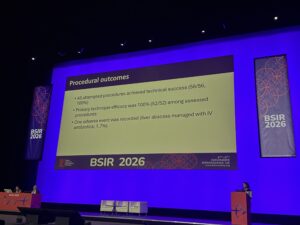
Technical success was achieved in all cases, with one major complication (liver abscess) reported. Primary technique efficacy at four to six weeks was 100% in all evaluable cases.
LTP occurred in 5/52 cases (9%) at a median follow-up of 27.5 months. Pardiwala reported that cumulative LTP incidence was 2.4%, 8% and 11.7% at one, two and three years, respectively. She noted that all LTP events occurred in the primary ablation group (5/34, 14.7%), with no LTP following prior embolization. Pardiwala underlined the importance of interpreting the LTP finding for the primary ablation group “with caution”, as the difference was not statistically significant perhaps due to a limited statistical power.
Median disease-free survival (DFS) was 12.6 months, with shorter DFS seen in the groups that had received prior embolization: 8.9 months for DEB-TACE and 4.4 months for TACE, compared with 18.8 months in the primary ablation group. Median overall survival (OS) was 50.6 months across groups, with OS rates of 87.4%, 83.9% and 64.8% at one, two and three years, respectively.
In light of the findings, Pardiwala suggested that future work should focus on establishing a well-powered, prospective cohort study with standardised follow-up and ablation margin assessment.