This advertorial, sponsored by Merit Medical, is only available in selected countries and geographies.

For interventional radiologists managing patients with complex oncological disease, percutaneous drainage is rarely a standalone procedure. Instead, it represents one component of a broader multidisciplinary treatment strategy, with the overall aim to improve symptoms or allow the patients to proceed with further oncologic interventions.
Sharing his clinical experience, Franco Orsi, director of the Interventional Radiology department at the European Institute of Oncology (Milan, Italy), says that drainage procedures are frequently required in patients with malignant biliary obstruction, postoperative or infected fluid collections, liver abscesses and in selected patients with the need for gallbladder drainage when surgery or endoscopic treatment is not appropriate or has not been successful.
Working within a comprehensive cancer centre means that many patients present with anatomically complex disease and significant treatment histories, factors that place particular emphasis on the performance and reliability of drainage devices to allow patients to advance to further treatment, Orsi explains.
“In oncological patients, drainage is usually part of a multimodal treatment pathway. For example, patients may need systemic therapy but cannot receive it because their bilirubin level is too high, so we first need to palliate the obstruction before treatment can begin,” he describes.
Procedural challenges beyond initial placement
In patients who have complex anatomy due to tumour-related distortion of the organs, previous surgery, or earlier interventional procedures, achieving access can be challenging, Orsi explains.
“In biliary procedures, one of the most difficult scenarios is when the ducts are completely disconnected after surgery, such as following an anastomotic leak. The ducts may also be minimally dilated, making access difficult. In benign obstructions, crossing the stricture itself can be particularly challenging, and the risks of infection and bleeding must always be considered.”
Yet, he states that technical placement is only the first step of the procedure that interventionists must consider, and the catheter must continue to function reliably after the patient leaves the interventional suite. “Dislodgement, occlusion, kinking, leakage, skin discomfort and the burden of catheter care may become clinically relevant during the following days or weeks,” Orsi says, acknowledging that oncological patients often require long-term catheter management.
Defining device characteristics
To Orsi, predictability is one of the key characteristics sought after in any interventional radiology (IR) device, “and drainage catheters are no exception”, he adds. “The catheter should advance smoothly while providing adequate pushability and torque control—these qualities are extremely important in daily practice.” Under fluoroscopy, the relationship between the marker, the drainage holes and the pigtail should be “unambiguous” he adds, while the locking mechanism should be “simple and reliable”.
Day-to-day, Orsi uses the ReSolve® catheter (Merit Medical) for his drainage procedures. He states that the characteristics of the device contribute to procedural efficiency by allowing him and his team to concentrate on patient anatomy rather than device behaviour.
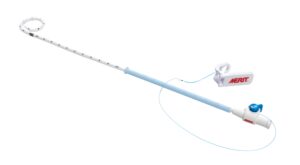
Returning to the concept of predictability, he details that the formation of the pigtail before deployment is critical: “The pigtail should form exactly as expected upon deployment, ensuring it sits correctly within the cavity for fluid collection.” This factor becomes increasingly important when fluid has been completely drained and the cavity walls collapse. If the catheter tip remains in the same plane as the pigtail, it is less likely to become embedded in the wall.
“This may not be the first feature interventionists would think about because they’re so used to benefitting from the design, but it’s a very important one,” Orsi says.
Other important features include the device’s locking mechanism and the configuration and size of the drainage holes. Regarding the former, Orsi notes that the locking suture should pass separately, rather than through the catheter lumen. This is a particularly valuable feature, as, in his experience with other devices, he has seen air leakage through the locking system. “When you’re dealing with pleural effusions or pneumothorax, air escaping through the locking mechanism can become a significant clinical problem,” he states.
Ensuring that drainage holes are distributed evenly along the catheter also helps during catheter exchange. Orsi illustrates that, when advancing the guidewire—especially one with an angled tip—it can sometimes exit through one of the side holes. “If the holes are clearly visible under fluoroscopy you can use torque control to redirect the wire and continue straight through to the catheter tip.”
An added benefit of reducing catheter exchange time is reduced radiation exposure to the operator. “Lower radiation exposure is important for operator safety,” Orsi says, “I started doing this work 30 years ago, and, at that time, devices and materials were far less advanced, and we often spent a long time positioning catheters correctly. Radiation exposure should, of course, be minimised for every patient. For operators, there is the additional concern of cumulative exposure across multiple procedures performed every day.”

Improving everyday practice
Overall, Orsi describes the ReSolve catheter as a technically well-developed device whose advantages lie in practical refinements rather than changing the underlying principles of drainage procedures.
“Its value is not that it fundamentally changes the drainage procedure, but one that reduces unnecessary device-related difficulties during an already complex intervention,” he states. “A well-designed catheter can support patient safety and comfort by facilitating controlled placement, limiting unnecessary manipulation and providing stable and effective drainage. A low-profile and manageable external component may also make catheter care easier for both the patient and the clinical team.”
However, he underscores an important principle: “The catheter alone does not determine the clinical outcome”, instead, outcomes depend primarily on correct patient selection, the timing of drainage, imaging guidance, operator technique, infection control, management of coagulation and appropriate follow-up.”
Orsi therefore defines the role of a high-quality catheter as a device which supports the procedure and reduces avoidable device-related problems: “It’s an important component of treatment, but only one component. A good drainage catheter does not replace clinical judgement or technical expertise. Its value is that it is predictable, allowing the operator to concentrate on the anatomy and on the patient rather than on the device.”