Jupiter Endovascular has announced the publication of full results from its SPIRARE II pivotal trial in EuroIntervention. The trial evaluated the Vertex thrombectomy system in patients with acute, intermediate-risk pulmonary embolism (PE).
According to a recent company press release, SPIRARE II met all primary and secondary endpoints at 48 hours, with symptom improvement sustained through 30 days. The publication builds on topline data first presented at EuroPCR 2026 (19–22 May, Paris, France), adding the complete clinical methodology, patient severity breakdowns and invasive physiologic outcomes.
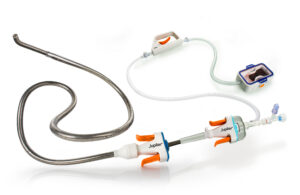
The Vertex system uses Jupiter Endovascular’s proprietary Transforming Fixation (TFX) platform. This is a single catheter designed to navigate flexibly through the right heart and stabilise on demand in the pulmonary arteries. The company says combining flexible navigation and stable support in one device addresses long-standing challenges in PE thrombectomy related to cardiac strain and reliable vessel access.
Of the 123 patients enrolled, 85% were classified as intermediate-high risk under the European Society of Cardiology (ESC) 2019 criteria. In a post-hoc analysis applying the 2026 American Heart Association (AHA)/American College of Cardiology (ACC) multi-society PE guidelines, 54% met the criteria for normotensive cardiogenic shock. In this state, normal blood pressure can mask underlying haemodynamic compromise and delay recognition, potentially increasing procedural risk.
For the primary endpoints, the mean reduction in right ventricular-to-left ventricular (RV/LV) ratio at 48 hours was 0.39 (95% CI: 0.33, 0.45; p<0.0001). The major adverse event (MAE) rate was 2.4% (3/123; p<0.0001).
Invasive measurements showed a 29% reduction in mean pulmonary artery pressure (mPAP; −8.5±6.3mmHg), with 50% of patients reaching complete mPAP normalisation (≤20mmHg). Systolic pulmonary artery pressure fell by 29% (−14.2±10.5mmHg) and total pulmonary vascular resistance by 26% (−1.7±2.3 Wood units).
Severe or very severe dyspnoea, measured using the modified Medical Research Council (mMRC) grade, fell from 58% of patients at baseline to 8% at 48 hours and 3% at 30 days, an 85% relative reduction.
Technical success was 100%, and no adjunctive thrombolytics were used. Mean thrombectomy time was 28.5 minutes (±15.8). Re-crossing of the pulmonic valve was not required in 83% of cases, and a super-stiff guidewire was not required in 39%.
“In a growing landscape of PE technology and research, we designed SPIRARE II to provide a more comprehensive look at the effect of PE treatment on a patient’s recovery. PE is fundamentally a cardiovascular disease, not just an obstructed vessel, and patient recovery is determined by haemodynamic normalisation and restoration of right heart function. That’s why we designed SPIRARE II to measure the full invasive haemodynamic profile by paired right heart catheterisation in every patient, alongside independent core laboratory assessment of imaging and independent adjudication of every safety event. This assessment allowed us a physiological view of how the device performs rather than relying on surrogate imaging or unadjudicated, site-reported outcomes,” said Catalin Toma, director of interventional cardiology at the UPMC Heart and Vascular Institute in Pennsylvania, USA, global co-principal investigator of SPIRARE II and chief medical officer of Jupiter Endovascular.
Sameh Sayfo, PE response team director at Baylor Scott & White The Heart Hospital in Plano, USA, and fellow global co-principal investigator, said: “SPIRARE II underscores the importance of device mechanics in achieving meaningful clinical outcomes. Rapid normalisation of haemodynamics, while maintaining safe right-heart navigation and procedural stability, has remained a key challenge in PE thrombectomy. With more than half of patients in this study presenting with normotensive cardiogenic shock, a population at heightened procedural risk, it is encouraging to see immediate restoration of haemodynamics with improvements sustained over time. These findings highlight the potential of this technology to rapidly restore cardiopulmonary function in patients with acute PE.”
Carl J St Bernard, chief executive officer of Jupiter Endovascular, added: “The publication of our SPIRARE II data in EuroIntervention reflects the dedication of the investigators and clinical teams. These results give us a strong foundation, and future post hoc analyses will help us better understand what drives recovery. Beyond this milestone, we see meaningful opportunity to extend our TFX platform to other complex cardiovascular anatomies, where stable access and precise, controlled intervention remain an unmet clinical need.”