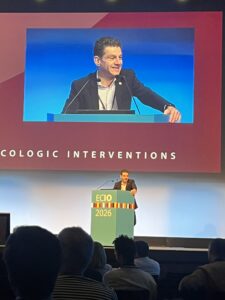
In a talk during the European Conference on Interventional Oncology (ECIO; 26–30 April, Basel, Switzerland) which questioned: ‘resect, ablate, wait; continue flipping coins or run randomised controlled trials (RCTs)’ in regard to the treatment of colorectal pulmonary metastases, Constantinos Sofocleous (Memorial Sloan Kettering Cancer Center, New York, USA) began by stating, “in the interest of time, I could say design RCTs and we could be done—but let’s see what the evidence tells us”.
First, the speaker referenced what has been learned in surgical literature. By doing so, he showed that, unlike primary lung cancer, where lobectomy remains the standard of care, for metastatic disease, limited resection, sparing normal lung parenchyma, has the same oncologic outcomes as lobectomy.
“Therefore, limited resection or minimally invasive treatment is recommended,” Sofocleous stated. “We know image-guided radiotherapy is an option, with great results for primary lung cancer, and good results for metastatic disease. However, for repeated tumours, there is an incidence of pneumonitis that can last as long as two years after treatment, in a small percentage of patients, which is just short of 8%,” he continued.
Further, Sofocleous added that, on the contrary, other ablation modalities have shown that there is no long-term impact on pulmonary function, and that they are well tolerated, and even if repeated, pulmonary function remains within the normal range.
“So, to answer the first question: for resectable tumours, waiting is not okay,” the speaker declared.
Then, Sofocleous highlighted several research papers which demonstrate that, in combination with ablation, chemotherapy breaks can be achieved particularly in patients with single tumours. Referencing his recently published paper in the journal CardioVascular and Interventional Radiology, the speaker described that, in 225 patients and over 700 tumours, it was demonstrated that a median chemotherapy break of one year was facilitated by treatment with ablation, with a significantly longer break for patients with one tumour compared to those with multiple.
“So why wait for chemotherapy?” Sofocleous asked the ECIO 2026 audience. “In patients that are not eligible for resection or ablation, yes, you have to wait. Either to downsize in order to treat, or to make sure that you are controlling extrathoracic disease before giving local therapy. That’s very important information.”
The speaker underlined that tumour size and number are key determinants of oncologic outcomes, making minimal margins of central importance when treating lung metastases. He stated that, “unsurprisingly, for lung metastases, like liver metastases, margin seems to be one of the most important technical factors impacting outcomes and local tumour progression”.
Discussing ablation confirmation software in relation to margin assessment, Sofocleous elaborated on data presented at the recent Society of Interventional Radiology (SIR) annual scientific meeting (11–15 April, Toronto, Canada) which looked at the results gained using new three-dimensional (3D) margin confirmation software with the application of deformable tissue modelling. Using this technology, he stated his team were able to achieve no local tumour progression at two years via intraprocedural assessment with a 10mm margin.
“If you did not have a 10mm margin, but achieved a 5mm margin without deformable modelling, that had the best sensitivity to detect those at risk of recurrence on immediate assessment.
And at four to eight weeks post-ablation scan, the same applies: the 10mm margin, with deformable modelling, has the best accuracy, while without deformable modelling it has the best sensitivity,” Sofocleous described. He added that, in these cases, he would choose sensitivity over accuracy “in terms of monitoring patients closely”.
In his final thoughts, Sofocleous asserted that clinicians should “definitely not flip coins”, but rather, should “watchfully wait for patients to be eligible for local treatment”. He stated that when comparing the appropriateness of ablation versus surgery, the option that is the “least risky and most likely to offer long-term tumour control” should be preferred, although saw safe ablation with adequate margins as superior to resection.
Returning to his initial statement regarding RCTs in this space, Sofocleous acknowledged that “problems” may arise when attempting to randomise this patient population but reiterated that the “highest level of evidence is needed at all times”, calling for continued research efforts in this space.