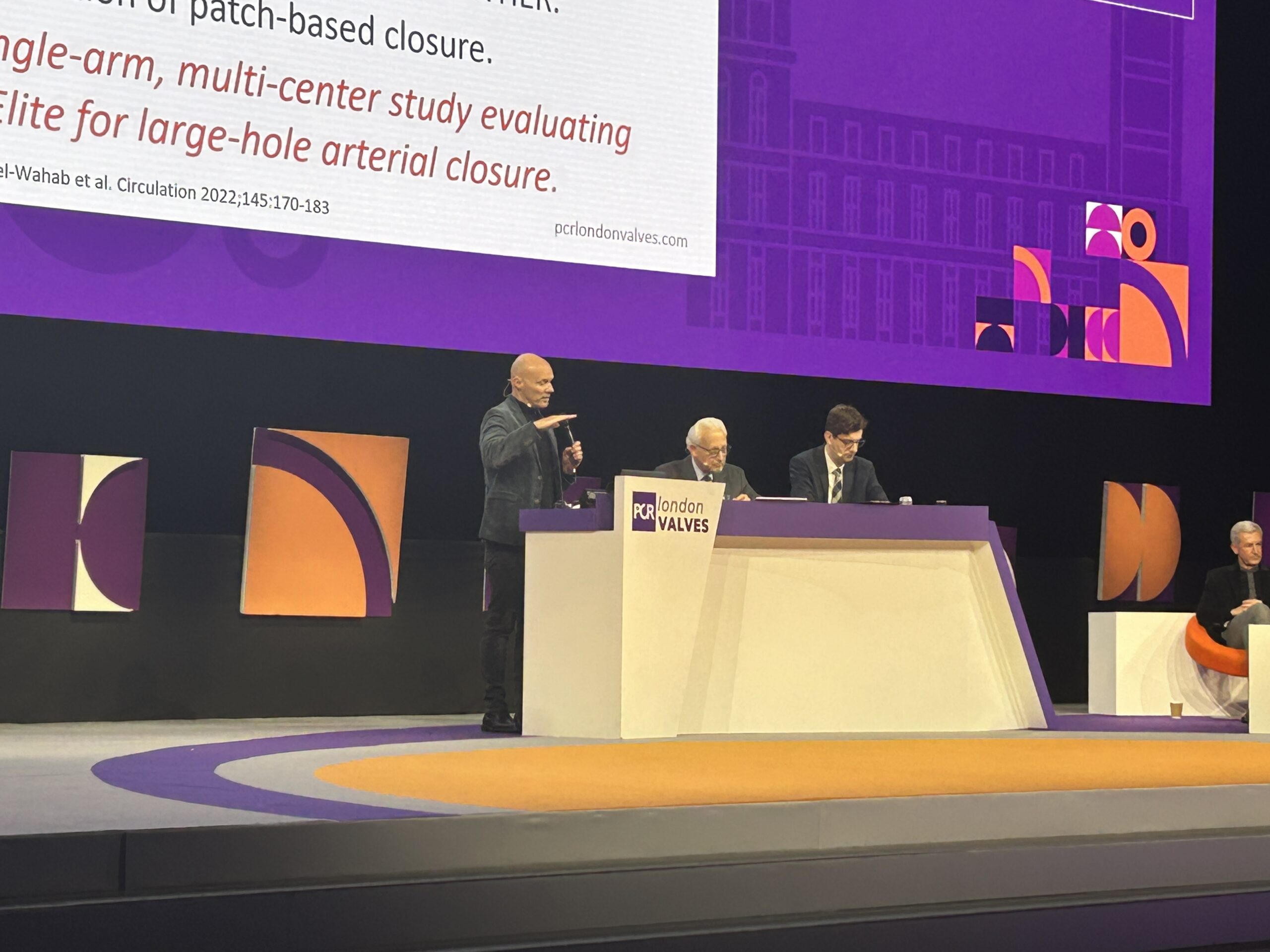
No major vascular complications were seen in the ELITE trial using the latest-generation PerQseal Elite (Vivasure Medical), a patch-based, resorbable, sutureless vascular device for large-bore arterial closure. Results of the trial were presented during a late-breaking trials session at PCR London Valves 2025 (16–18 November, London, UK) by Nicolas van Mieghem (Erasmus University Medical Centre, Rotterdam, the Netherlands).
The trial included a total of 121 patients undergoing transcatheter aortic valve implantation (TAVI) or endovascular aneurysm repair (EVAR) procedures at 12 centres throughout Europe, designed to test the safety of the device by following major access site complications at 30 days, as well as its efficacy in terms of time to haemostasis.
“The last randomised controlled trial on access site closure was the CHOICE-CLOSURE trial that was comparing plug-based closure with suture-based closure, and the complication rate was more than 10%,” Van Mieghem said in his presentation, describing patch-based closure as a “different concept”.
PerQseal Elite consists of two core components, he explained, the closure patch and a fixation scaffold. The system is compatible with a 0.035-inch (0.89mm) guidewire and is completely resorbed within six months. Arteriotomies up to 22Fr can be closed using the technology.
Describing the ELITE trial population, Van Mieghem detailed that patients had a mean age of 78 years and 70% were male. The majority of cases (79%) involved TAVI procedures.
On the safety outcomes seen in the trial, Van Mieghem reported that there were no instances of major vascular complications at 30 days, with only two minor access site complications requiring manual compression. Average time to haemostasis stood at less than one minute, meaning that the trial met both primary safety and efficacy endpoints.
“The ELITE primary endpoints demonstrate that the PerQseal Elite is a safe and effective device for large bore arteriotomy closure with low complication rates and also rapid and durable haemostasis. Haemostasis was usually achieved without manual compression,” said Van Mieghem, who added that the device is “characterised by an ease of use and a faster deployment as compared to competitors”.
Following the presentation, Van Mieghem was asked by Howard Herrmann (Perelman School of Medicine at the University of Pennsylvania, Philadelphia, USA) to comment on the applicability of the device, given reportedly low rates of vascular complications seen following TAVI procedures in real-world data.
“In terms of the access site complications in general, indeed in the TVT registry, access site complications are low, but if you look at prospective studies, for instance at the VANTAGE prospective study, then the complication rates tend to be somewhat higher—more around five to 10%,” he commented. “Minor complications are much more common, and we are living in a day and age where procedure volumes are increasing so I do feel that there is a need for devices that allow for faster haemostasis. As we are training more and more people to do these cases, I think it makes sense to come with a technology that democratises access site closure.”