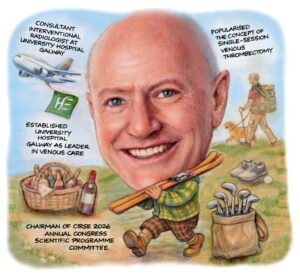
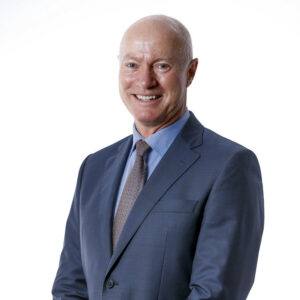
 As an interventional radiologist who specialises in venous pathology, Galway-based Gerry O’Sullivan first thought this move to be a risk. Yet, throughout his career, his expertise has played a leading role in establishing University Hospital Galway as a key centre for endovascular intervention, driving innovation with cutting-edge technology. Here, well-known figure within the venous and interventional radiology (IR) community O’Sullivan shares details of his life and career with Interventional News.
What initially attracted you to a career in radiology, and what led you specifically towards IR?
My dad was an obstetrician and gynaecologist. I didn’t have the first clue about radiology, until one day when I was in my second year of medical training and he came home and told me about this new radiologist in the hospital in which he worked. He said this guy was so smart and the technology he was using to diagnose things was so advanced that—in my dad’s opinion—this is where the future of medicine was headed. My dad was rarely wrong.
I started to pay a bit more attention to radiology then, and as an intern I saw that radiology was central to the functioning of the hospital. The technology was impressive. The tests made a difference to management. We weren’t sending a blood test and then not acting on it. We obtained a radiological examination, and it meant a turning point in the diagnostic pathway—I liked that.
But I rapidly realised I did not want to spend all my time just looking at images, and this ‘IR’ area looked amazing. After two more years in internal medicine and obtaining the Member of the Royal College of Physicians of Ireland (MRCPI)—the postgraduate examination essential at that time for entry into radiology—I was absolutely certain that IR was for me. So, then I had to do four years of ‘general’ radiology before specialising, which gave me a good grounding across the specialty, which has really stood be in good stead since. I also realised that I continued to be drawn to the dynamic, fast-paced technical aspects, teamwork and immediate results in IR.
Who were your career mentors and what was the best advice that they gave you?
I am not sure about the advice, but certainly, those who inspired me the most were all interventional radiologists—many of them legends. In the UK, Irving Wells in Plymouth; Anna Maria Belli and Tim Buckenham in St George’s Hospital in London; and in the USA, Mike Dake and Stephen Kee in Stanford; Bob Vogelzang in Chicago; as well as Michael Lee in Dublin, Ireland. Wells was an absolute star.
Could you describe one of your most memorable cases?
There are two actually: When I arrived in Plymouth in 1993, the IRA had just bombed Canary Wharf. Plymouth is a Royal Naval citadel, and an Irish accent wasn’t necessarily an advantage. Irving went out of his way to make me feel at home. One day after the Fellowship of the Royal College of Radiologists (FRCR) part one, he let me do my first superficial femoral artery (SFA)
angioplasty. I was so excited I nearly wet myself. He told me I would need to explain to the patient what was going on, in language the patient would understand. So, no talk of “lesions” or “angioplasty”—I had to keep it real. So, Irving crossed the lesion and basically all I had to do was inflate the balloon. I then uttered the immortal: “Now sir, I am just going to blow up…”. This was the cue the entire department had been waiting for. Somebody set off a blaring alarm. One of the nurses started screaming. The lights started flashing. Somebody threw confetti across the room. Even the patient got in on the act and pulled out his WW2 helmet, which he put on his head. I was in a state of shock trying to figure out what was going on, but then Irving came in and winked. Everyone was laughing their ass off. Eventually the penny dropped: an Irish man telling somebody they were just about to blow something up. Hilarious.
The second memorable case involved the first ‘trellis’ case in Ireland. July 2003. I had moved back to Ireland in 2002, and Stephen Kee and a couple of colleagues who were with a nascent company called Bacchus Vascular (a Tom Fogarty innovation along with all his others) came over with this amazing new device for deep vein thrombosis (DVT).
Sure enough, a lovely lady with a big iliofemoral DVT presented to the emergency department, which normally would have meant intensive care unit, followed by catheter-directed thrombolysis for two to three days and then stenting. Using this new device, we were done in one hour and I could see the future lay in pharmacomechanical thrombectomy and ‘single-session’ therapy. Nowadays, with modern large-bore mechanical thrombectomy devices this is commonplace. A Road to Damascus type of moment.
Having practised in Ireland, the UK and USA, how has working internationally impacted your career?
Breadth of experience, willingness to embrace new ideas and different ways of working, ability to think laterally, more cognisant of my strengths and (especially) my weaknesses. Working in the UK gave me a very solid foundation and structure, working in the USA opened my eyes to possibilities, working in Ireland has meant fulfilling these dreams. Working in Galway with our intense medical device culture—the industry employs perhaps 20,000 people within 20 kilometres—means that I am constantly exposed to radical new ideas and concepts.
You have a special interest in venous interventions. Which are the trials to watch in this area over the next year?
There is a whole raft of pulmonary embolism (PE) data emerging and will continue to emerge with large-bore mechanical thrombectomy, driving the PE trials and changing the landscape, but also, the HI-PEITHO trial involving ultrasound-assisted catheter-directed thrombolysis (CDT). We have a special session at the 2026 Cardiovascular and Interventional Radiological Society of Europe (CIRSE; 5–9 September, Copenhagen, Denmark) directed purely at this.
What do you anticipate will be the next big development in the treatment of venous thrombosis?
The future is really exciting. We have progressed so, so far compared to where we started. Really it could not have happened without the symbiotic relationship between medicine and industry. Venous stents have been a huge innovation, but sometimes, particularly in non-thrombotic iliac vein lesions (NIVL), we can’t tell if a stent is in fact required. So, post-balloon angioplasty we need a tool to assess the amount of force still pressing in on the vein wall and quantify it. That is coming soon and will really be a huge step forward.
I think venous thrombectomy devices will continue to be refined, but large-bore thrombectomy devices are definitely here to stay. Technologies to address venous in-stent restenosis will become more prevalent, dealing with the material inside the stents. We were involved in a first-in-human (FIH) case in Galway in July 2025 using the Recana device (Intervene). It worked very well and I suspect we will see other devices enter this space using different technologies to address this challenging patient cohort.
Remodelling the immediate peri-vascular environment by injecting steroids into the wall of veins is delivering exceptional improvements, such as the Bullfrog micro-infusion device (Mercator MedSystems). Finally, I see a big future for devices to address inflow and reduce the impact of scarring using endovascular techniques. We have recently started trialling the FLEX dynamic scoring catheter (VentureMed), which employs kinetic remodelling. It has really delivered.
What are the biggest challenges currently facing IR?
- Identity! What does IR mean? It means different things to different people. For me, it means essentially that I function as a clinician: ward rounds, in-patient beds, clinics, a secretary to arrange admissions, type letters and send appointments; letters to general practitioners (GPs), other clinicians and the patients themselves. Essentially, I squeeze in diagnostic radiology (DR) around the edges. The challenge is that some radiology groups do not value the IR aspects of the job. I am lucky that my group does. But looking ahead, all interventional radiologists will need time in their job specifications for these tasks. They can’t be covering computed tomography (CT) for instance while simultaneously conducting an IR clinic.
- Where IR sits with respect to DR. Divorce, stay together, limited partnership, maintain existing relationships. I suspect there will be several models.
Were there any career risks you took that, in hindsight, proved pivotal?
When I was young, I wanted to be a professional golfer, but when I was 16 my dad told me, (quite cruelly) that I wasn’t good enough. He was a really good golfer, so he could judge. I thought his lifestyle looked pretty good, not realising the years of study and sacrifice that lay ahead. I have been very fortunate that he was so brutally honest that night. Medicine and particularly IR have been a really happy fit for me.
The second risk was deciding to concentrate—to a significant extent—on purely venous pathology from when I left Stanford in 1999. It was not a particularly popular area to get into. At that time, it was all about the aorta, and in Stanford I did get amazing exposure to aortic pathology, particularly aortic dissections. However, when I moved to Rush-Presbyterian in Chicago, USA, in 1999, I soon realised dissections were quite rare and venous pathology was very common and completely undertreated. So increasingly, I have specialised in veins. Starting with central venous access, then dialysis cases, then varicocele embolization, then pelvic vein embolization, DVT, venous reconstruction, PE thrombectomy, and so on.
It has been a brilliant journey and there is still so much more to do. I have been hugely supported by so many colleagues along the way, too many to mention, but my colleagues in Galway led by Joe Murphy—probably the smartest radiologist and clinician I have ever met—have been amazing.
What leadership responsibilities have had the greatest impact on your career satisfaction?
I joined CIRSE as a trainee in 1996. While in the USA I joined the Society of Interventional Radiology (SIR) and became a fellow of that society in 2016, which, along with my fellowship of CIRSE, is a career highlight. I am still very much involved in SIR and am greatly looking forward to SIR 2026 (11–16 April) in Toronto, USA. On returning to Europe in 2002 I rekindled my involvement with CIRSE. To be honest, I absolutely love CIRSE. It represents all that is good in IR. I have often said that if Daniel Waigl and his team in Vienna were in charge of any healthcare system it would drastically improve.
What does your life outside of medicine look like?
Life outside of medicine includes my wonderful wife Karena, who I met on the beach in Ios, Greece, in 1990. She is an old-age psychiatrist—she is my “Galway Girl”. We have four great kids aged 19–25. I still love golf, and currently play off a handicap of 1.2, I also love travel, dogs, skiing, hiking. I was born in Calgary in Canada, and it is an ice hockey hotbed. I will be proudly supporting the Canadian team at the Olympics in Milan in February 2026. Equally, I am a passionate supporter of the Irish rugby team and have been to four Rugby World Cups. I live for the day when we get past the quarter final. Lastly, red wine—especially GSM!