Genicular artery embolization (GAE) has emerged as a minimally invasive treatment option for patients with osteoarthritis-related knee pain unresponsive to conservative therapy. Here, Florian Nima Fleckenstein (Charité-Universitätsmedizin Berlin, Berlin, Germany) describes how, by selectively occluding hypervascular synovial branches, the procedure targets chronic low-grade inflammation and aberrant neoinnervation, key drivers of osteoarthritis pain.
Until recently, the most commonly used embolic agents were imipenem/cilastatin (IMP/CS) and permanent microspheres. Both have demonstrated efficacy but carry notable limitations. IMP/CS, an antibiotic compound that self-aggregates into transient crystals, provides temporary vessel occlusion with excellent safety but lacks regulatory approval and size calibration. Permanent microspheres, in contrast, offer controlled particle size but remain in the vasculature, potentially provoking prolonged inflammation and increasing the risk of non-target embolization.
Rapidly resorbable, gelatin-based microspheres have been developed to bridge this gap. These calibrated, spherical particles are designed to dissolve within hours, combining the short-term safety of temporary embolics with the precision of modern microsphere technology.
A recent prospective study conducted at Charité-Universitätsmedizin Berlin that was presented at the 2025 Cardiovascular and Interventional Radiological Society of Europe (CIRSE) annual meeting (13–17 September) in Barcelona, Spain, evaluated the safety and performance of rapidly resorbable, gelatin-based microspheres (Nexsphere-F; Nextbiomedical) in 194 participants—239 procedures—with symptomatic knee osteoarthritis.
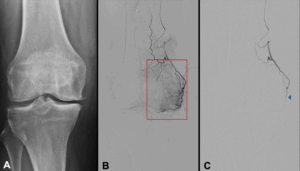
Figure 1: A) X-ray image of a 62-year-old patient with predominantly medial knee osteoarthritis (Kellgren–Lawrence grade 3). B) Pre-interventional angiogram showing pronounced hyperperfusion in the pain-correlated area supplied by the descending genicular artery; the patient’s characteristic pain was reproduced during intra-arterial contrast injection. C) Post-interventional DSA: Following embolization of the synovial hyperperfusion using temporarily resorbable microspheres, complete resolution of the hyperaemia is observed. Blue arrow: Successful, temporary embolization of the target vessel.
All procedures were technically successful. Mild, self-limiting skin discoloration occurred in 6.3% of cases, and no moderate or severe adverse events were observed. Median numeric rating scale (NRS) pain scores improved from seven (IQR 6–8) at baseline to three (IQR 2–5) at six months, with significant functional gains across all Knee Injury and Osteoarthritis Outcome Score (KOOS) domains. Between 69% and 73% of participants achieved improvements exceeding the minimum clinically important difference.
These results confirm that GAE using rapidly resorbable, gelatin-based microspheres provides substantial pain and function improvement with an exceptionally low rate of adverse events. Compared with previous data on permanent or antibiotic-based embolics, rapidly resorbable, gelatin-based microspheres demonstrate a more favorable safety profile while maintaining strong clinical efficacy.
As GAE continues to evolve, the development of purpose-built, resorbable microspheres marks an important step toward safer and more standardised embolization techniques for musculoskeletal pain management.
Florian Nima Fleckenstein is an interventional radiologist and clinical scientist at the Charité- Universitätsmedizin Berlin, Berlin, Germany.